
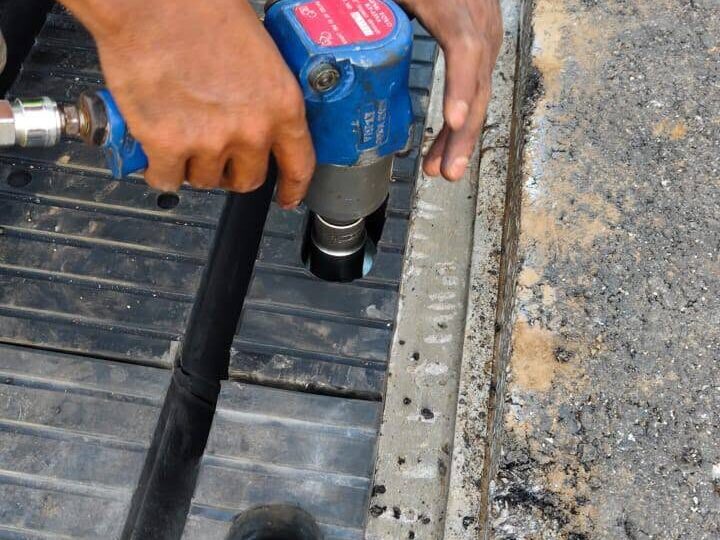
In engineering structures such as bridges and viaducts, the performance of expansion joints—which safely accommodate traffic loads and absorb thermal structural movements—depends not only on material quality, but fundamentally on installation details and, most importantly, the quality of the mounting surface.
While rubber expansion joints possess high flexibility to absorb large displacements and rotations, even the smallest irregularity on the substrate surface can reduce the service life of the entire system by half. So why is surface preparation so critical in rubber joint installation?
1. Surface Irregularities and Stress Concentrations
Rubber expansion joints are anchored to the concrete deck or abutment using structural anchor profiles and bolts.
- The Problem: Unevenness, surface fluctuations, or elevation discrepancies on the mounting seat cause unbalanced load distribution across the rubber body.
- The Result: Dynamic wheel loads from passing traffic induce severe stress concentrations on non-coplanar contact points. This leads to premature tearing of the elastomeric material or loosening of the anchor assemblies.
2. High-Performance Grout Application and Leveling
Preparing the blockout recesses and seating surfaces requires absolute precision:
- Substrate Cleaning: Laitance, loose concrete, oil, and dust must be thoroughly removed via sandblasting or mechanical scarification to expose sound concrete.
- Non-Shrink Repair Mortars: The seating base must be cast using non-shrink, high-early-strength epoxy or cementitious grouts. Substandard mortars deteriorate under repeated dynamic impact loads, causing joint movement and settlement.
3. Waterproofing Integrity and Anchor Reliability
A key function of rubber expansion joints is preventing water ingress into the underlying superstructure and substructure.
- Seating Uniformity: If the mounting surface is not leveled seamlessly, the sealing lips of the rubber element cannot maintain uniform pressure against the substrate. This allows water and de-icing salts to seep under the joint, triggering freeze-thaw damage and rebar corrosion.
Conclusion
No matter how high the manufacturing quality of a rubber expansion joint is, it cannot deliver its intended service life unless the mounting surface is prepared flawlessly. Achieving a perfectly level substrate, correct anchor embedding depth, and choosing the proper non-shrink grout are the essential engineering steps to minimize maintenance costs and ensure long-term riding comfort.
No responses yet